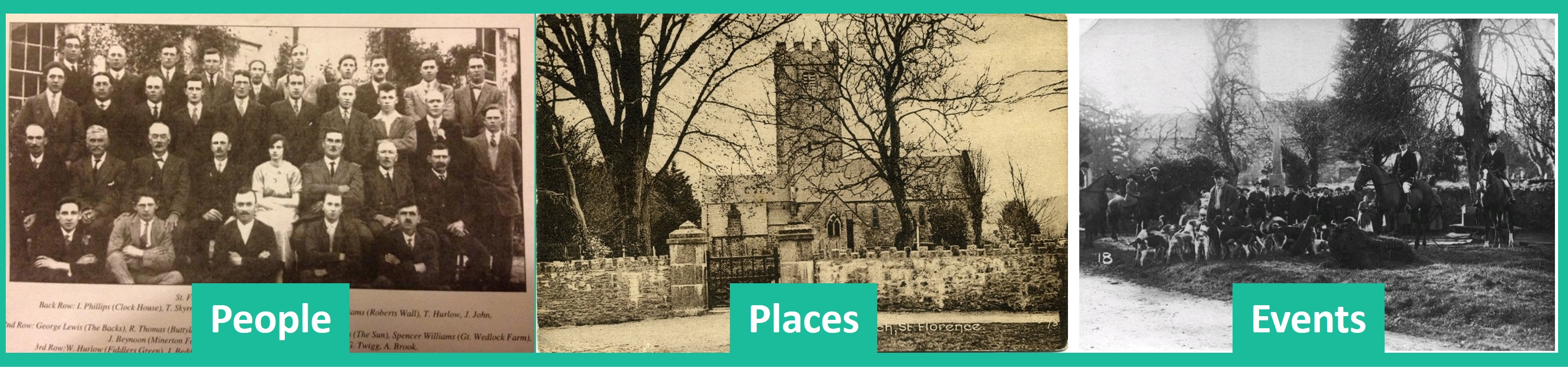
Some online content about St. Florence.
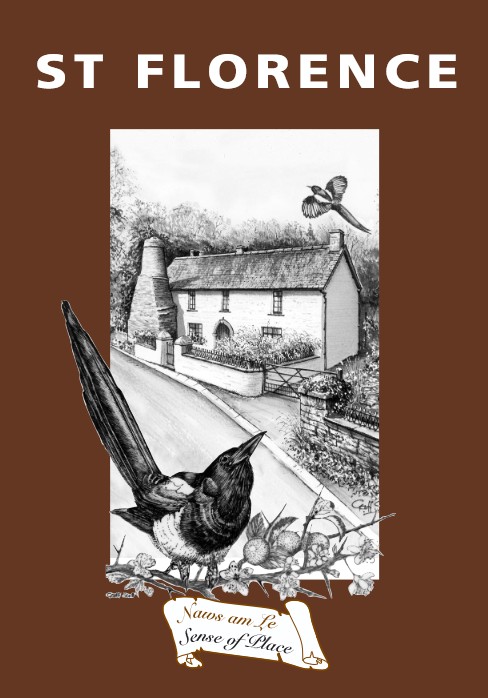
Text researched and written by Owen Thomas of St Florence
in conjunction with Dyfed Archaeological Trust
Design by Waterfront Graphics
Illustrations by Geoff Scott
Published by SPARC
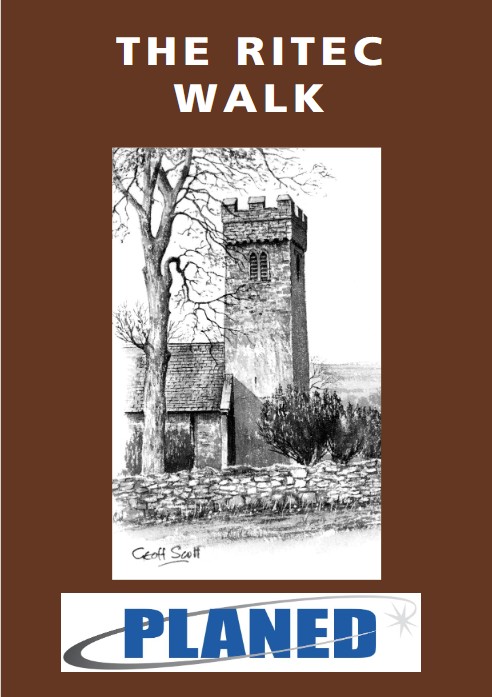
Design by Waterfront Graphics
Illustrations by Geoff Scott
SPARC © 2001
Published by SPARC
PDFs of two pamphlets related to St. Forence.
The illustrations, by Geoff Scott, are well worth looking at!

The current village school web site has a bit of the history of the village school.
by H. Thornhill Timmins
A travelogue written in the late 19th century, with lots of sketches, but sadly none of St. Florence.
The book is available as hardcopy from the Gutenberg Project and is also available as a free e-book.
There is not a lot about
Once more a pleasant field-path beguiles our errant footsteps. Leading across an open common, it presently drops into a narrow by-lane, which winds among hazel copses and undergrowth beside the marshy course of the Ritec, where cattle are browsing leisurely, half hidden amidst lusty water-plants.
Anon our lane degenerates into a hollow watercourse fringed with the greenest of mosses and wineglass ferns; insomuch that, like Agag, we are compelled to walk delicately across the rough stepping-stones that here do duty as a footpath; while the hedgerows fairly meet overhead in a tangle of wild roses, hawthorn and fragrant honeysuckle.
Emerging all too soon upon the dusty highway, we approach the pretty village of St. Florence. Being by this time not a little 'sharp set,' we enter a modest wayside inn, and proceed to whet our appetites upon the rations that the gute verständige Hausfrau soon sets before us. Let us unfold our simple bill of fare: New-laid eggs galore; a mighty loaf of likely-looking bread, sweet from the clean wood oven; and a draught of the 'cup that'—in moderation—'cheers, but not inebriates.'
In one corner of the low-ceiled room, the glass panels of an old-fashioned cupboard reveal a heterogeneous collection of rustic crockery-ware. The narrow mantel-board is adorned with a curious centrepiece, representing Wesley preaching to a sham china clock. This chef d'œuvre is supported on either hand by china figures, rather the worse for wear, riding to market upon a pillion; of which the rickety mirror behind renders a dull and distorted replica.
From the opposite wall the bucolic face of a former proprietor stares stonily out upon us, as he grasps his doll-like daughter's arm after the manner of a pump-handle; this interesting group being flanked by the inevitable memorial cards to lost ones long since 'buried.'
Meanwhile, as we ply the peaceful calumet, mine hostess tells of quaint old customs that, until only the other day, survived in this quiet countryside. 'I mind the time,' says she, 'when I was a girl, when there used to be a Vanity Fair in the village every Michaelmas tide. It lasted three whole days, and the men and maids would turn out in their best then, and all the housen must be smartened up and put in order; and Squire, he give every working man in the place a bran-new suit of clothes to his back. Ah, there was fine doings then, and I've a-hard tell that they'd used to run a keg of spirits, or what not, from the big cellars down Tenby way. But that was afore my time.'
A stroll around the village reveals some picturesque corners here and there; a few of the older cottages retaining the vast rounded chimneys, bulging ovens and pointed doorways of an earlier age. The church, too, contains attractive features. A peep into the little edifice reveals a curious vaulted interior, with its queer 'squint' passage set askew, and flat limestone arches of peculiar form on either side of the chancel.
The honours of the place are done by a garrulous old dame, whose russet-apple complexion, set amidst well-starched frills above a homespun 'whittle,' shows how well she has weathered her fourscore hard-working winters.
Upon the gable wall outside, we notice a memorial slab commemorating a venerable couple who attained the mellow ages of 102 and 104, respectively; and a singular epitaph on Archdeacon Rudd: while the broken shaft of an ancient cross rises amidst the well-tended monuments of this flowery God's acre.
On our return to Tenby we pass a ruined water-mill, standing in a wooded dingle beside a reed-grown stream. Lanes and field-paths lead us down the valley of the Ritec, beside a group of tumbled houses whose massive, ivy-wreathed walls, with their narrow loopholed windows, may possibly guard those big cellars of which we have lately 'a-hard tell.'
Thence through a hollow dingle, where golden Fritillary butterflies float to and fro in the dappled sunlight; and where the fast-disappearing badger may still at times be met with. Anon we diverge to Carswall, to examine a group of remarkable stone buildings with vaulted chambers, huge fireplaces and bulging chimneys—puzzling objects to the archæologist. From Carswall we strike across upland pastures, where a farm lad is 'tickling' the ruddy soil with a primitive kind of harrow, composed of a bundle of brushwood drawn behind a horse.